

The quiet reason your feet are swollen and aching by 3pm, and the fix most people get wrong

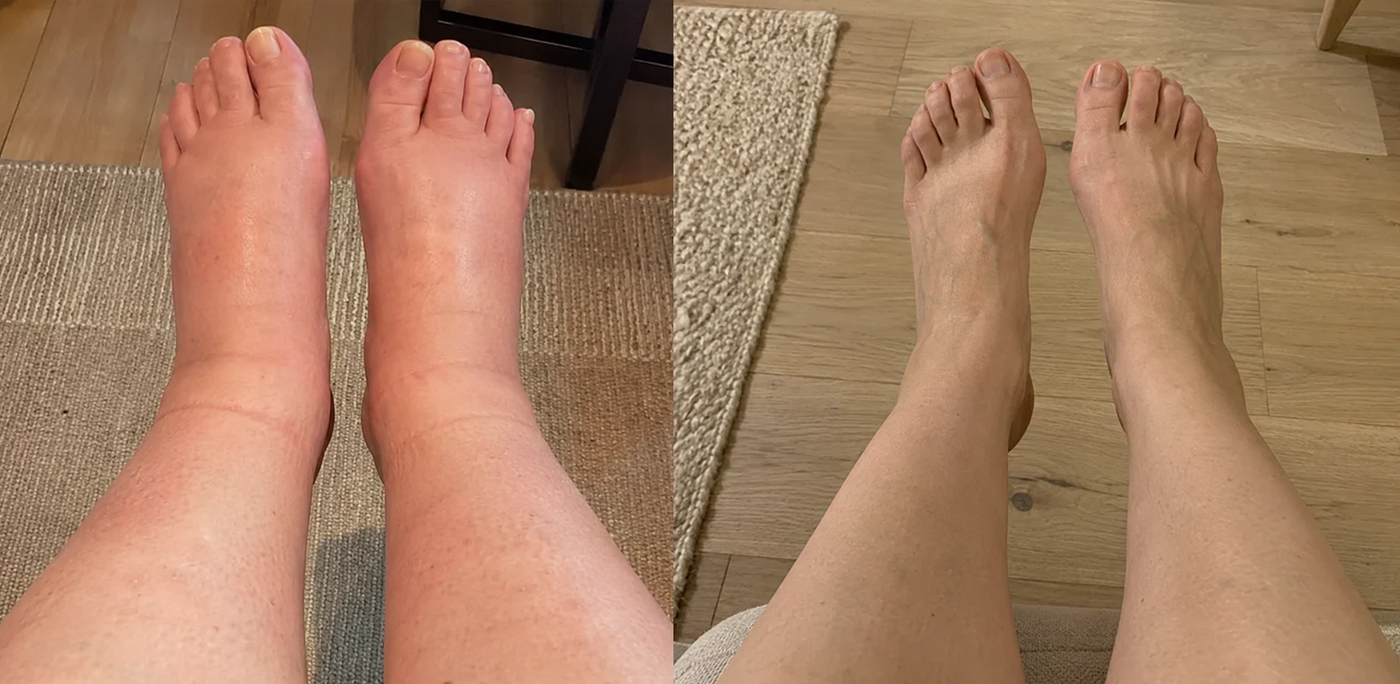
You take your shoes off at the end of the day. And there they are.
The ache across the arch. The heaviness in your ankles. The faint sock line pressed into swollen skin you have learned to ignore.
Tired feet quietly shrink your day. The walk you used to take after dinner. The standing you never gave a second thought. And nobody explains why it keeps happening. It just does.
So you do what most people do.
You try things.
You have probably already tried most of what is out there
The gel insoles. The arch support inserts that felt great for a week. The expensive orthopedic shoes that helped, until the ache quietly came back.
And somewhere along the way you accepted the thought I hear in my clinic almost every day.

I have been a podiatrist for sixteen years. I hear that sentence more than almost any other. And for a long time, I am ashamed to admit, I did not have a better answer.
Then I noticed a small group of patients who never had the problem.
Nurses. Long haul cabin crew. People who stood for twelve hours and walked out comfortable.
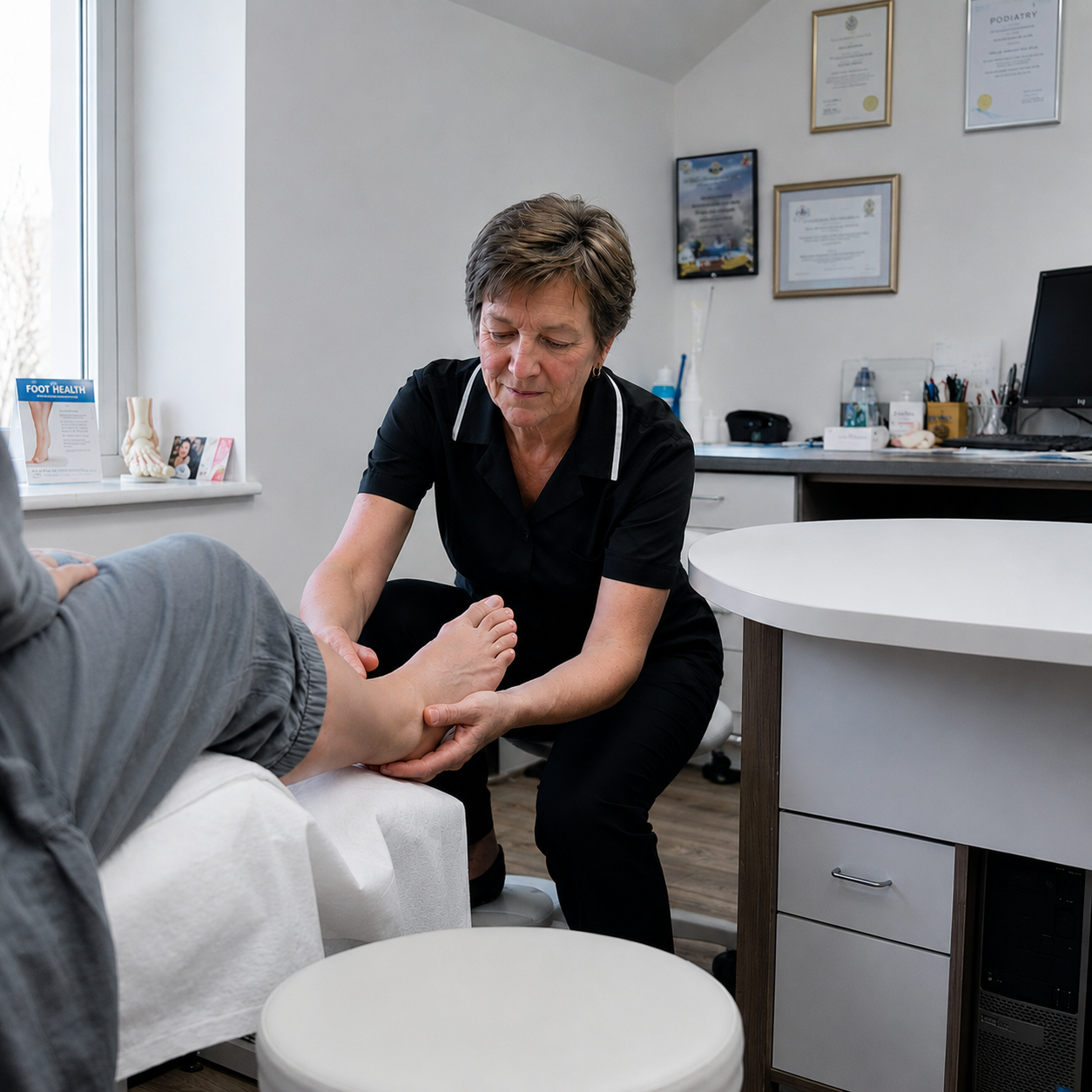
What a hospital ward taught me that a clinic never did
The people who did best did not have the most expensive shoes. They were not doing special exercises. They supported the foot continuously, all day, every day, in the one thing they were already wearing from morning to night.
Their socks.
Not a therapy sock pulled on for an hour. The actual socks they wore through every shift. Built around graduated compression and a structured arch, doing quiet work with every step.
And the more I looked, the more obvious it became why nothing else had worked.
Why every insole you have tried has only done half the job
Here is the part nobody explains. Foot fatigue and swelling are not made in the sole of your foot. They are made in the circulation underneath it. Stand for hours and blood and fluid pool in the lower leg. Pressure builds. The arch drops under the load. By mid afternoon your feet feel heavy, swollen, and sore.
An insole props the arch from below. But it does nothing about the fluid. It is like bailing water out of a boat without plugging the leak.
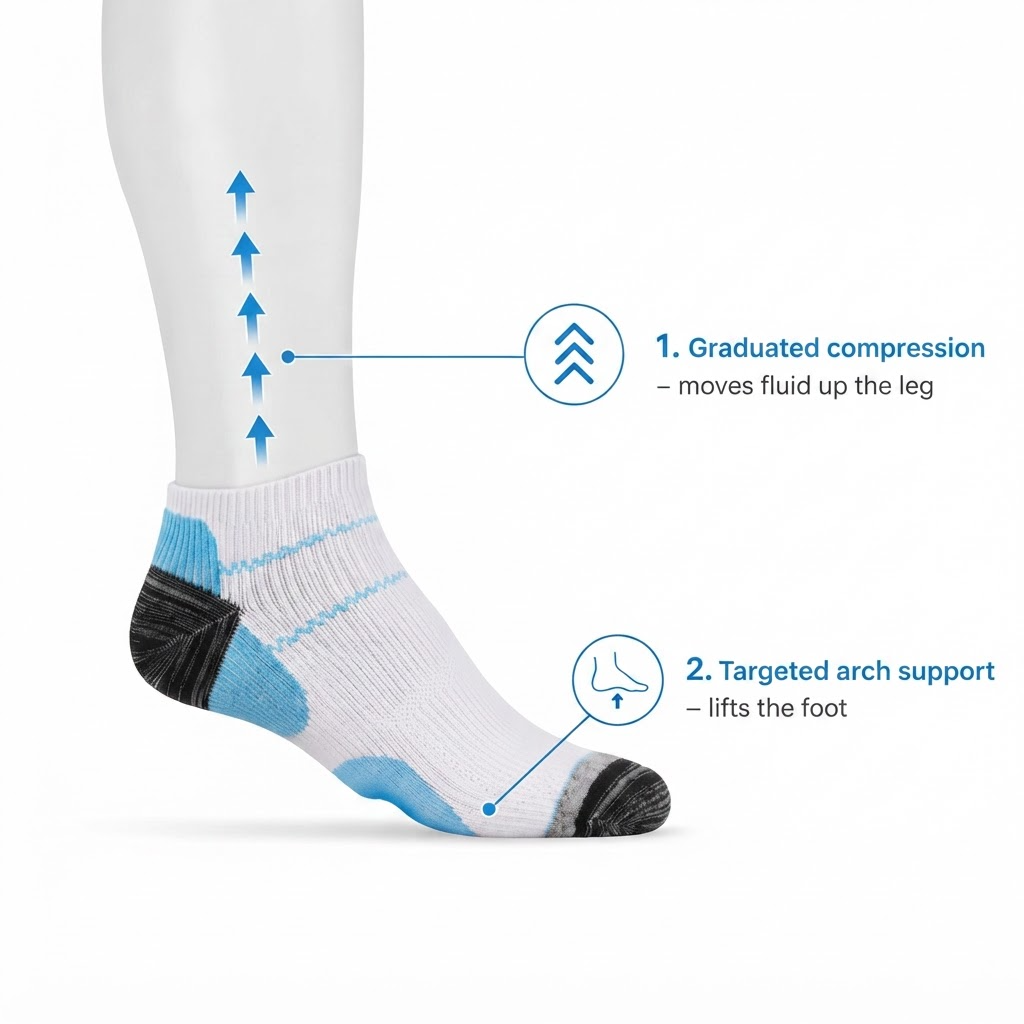
The real fix does two things at once. Gently push the fluid back up the leg. Hold the arch lifted while you move. Graduated compression does the first. A structured arch zone does the second. And that is exactly what those nurses and cabin crew were getting all day, for free, without ever calling it a treatment.
The three things that actually matter (and why people get them wrong)
When patients ask me what to look for, I tell them it comes down to three things. Get them right and the daily ache usually fades. Get them wrong and you are wasting money.
This is the one almost everyone gets wrong. Your foot does not need support for an hour. It needs it for the eight, ten, twelve hours you are actually on it. The once a week soak and the insole you keep meaning to use cannot compete with support that is simply there, the way the socks you put on each morning are. Not intensity. Frequency.
A sock you do not wear does nothing. Comfortable, breathable, and invisible inside your normal shoe is not a luxury. It is the reason the thing keeps working, because it is the reason you keep it on.
Plenty of compression socks squeeze the calf and stop there. That helps circulation but does nothing for the arch collapsing under you all day. The piece most people miss is a tighter weave arch zone built into the sock itself, lifting the plantar fascia a few millimetres with every step. Compression for the fluid. Structure for the arch. One without the other is half the job.
Why long compression stockings are the reason most people quit
I want to be honest, because this is the real barrier. For years the only proper option I could point patients toward was knee high medical compression. And almost every one of them said the same thing back to me. Hot. A struggle to pull on. And it looks like exactly what it is.
So they did not wear them. And a sock in a drawer helps no one.
This is the gap I spent months trying to fill: a low cut, good looking, genuinely comfortable sock that still delivered real graduated compression and a real structured arch. Not a surgical stocking with a softer label. Something a person would actually want to wear every day. Which, as we have covered, is the whole point.
The only compression sock I now point my patients toward
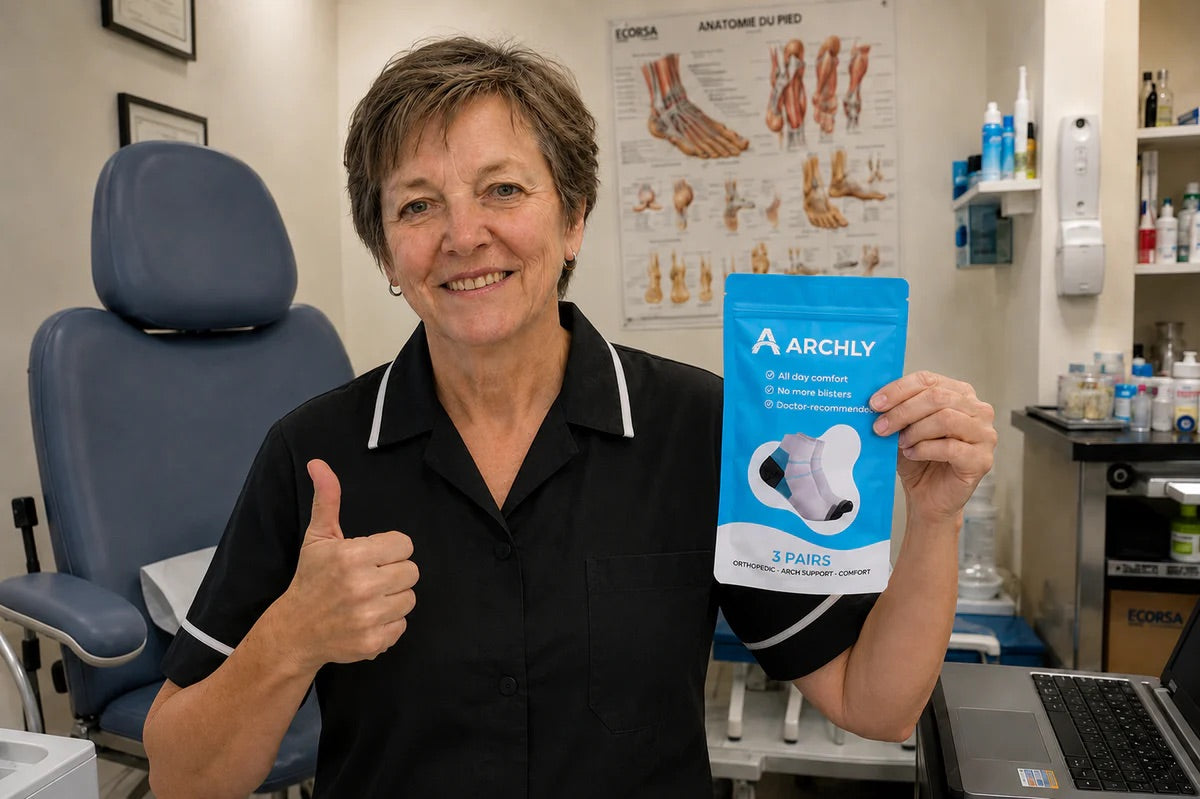
One brand was consistently different. Archly make what I consider the most sensibly designed everyday compression sock for people on their feet. I began recommending them several months ago and have not stopped. This is not a surgical stocking. It is a low, breathable, ankle height sock built around two things at once: graduated compression to keep fluid moving, and a dense arch zone that lifts the foot with every step.
Every pair is engineered around the details that decide whether someone actually keeps wearing them:
Slightly firmer at the ankle, easing gently toward the calf. This is what keeps fluid from pooling, and what takes the heaviness out of your feet by the end of the day.
A dense weave zone that lifts the plantar fascia a few millimetres with every step. This is the piece gel insoles cannot replicate, because it moves with your foot instead of sitting flat underneath it.
No toe seam digging in. Mesh ventilation so feet stay dry. A low profile that disappears inside trainers, work boots, and dress shoes. Comfortable enough to forget, which is exactly why people keep them on.
The fit is the part I want to underline. Two simple sizes by shoe size, a weave that hugs the foot across the range, and a cut so low nobody can tell it is anything other than a normal sock. That is the whole difference between a sock that works and a sock that sits unused.
The results speak for themselves
I want to be honest about timelines. This is not something that fixes everything in a day. What it does is work every single day, consistently, in a way no occasional insole or weekly soak can replicate. Most people start to notice a difference within the first few days to two weeks. The notes below come from real wearers: nurses, travelers, and people on their feet all day.
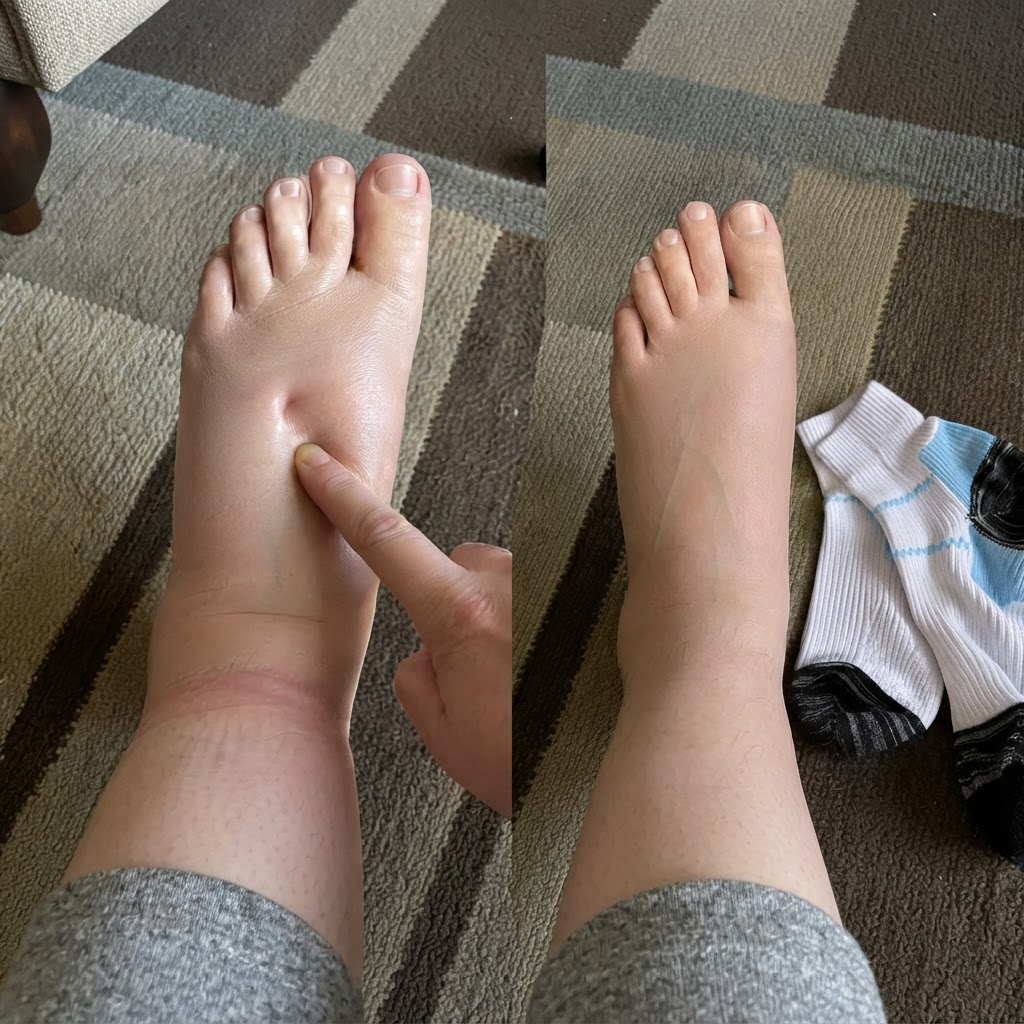
 Before
 After 4 days
“I am a ward nurse and my ankles used to balloon by hour eight. I'd tried insoles, I'd tried propping my feet up. These I just put on in the morning and forget. Four days in and the swelling that used to be guaranteed is mostly gone. I don't know how else to describe it.”
 Before
 After 12 days
“Honestly I was sceptical. I've been sceptical about everything for foot pain for about four years. I took a photo at day one just to prove to myself it wasn't working. Had to take another at day twelve because the first one made it look like it was. It was.”
 Before
 After
After“I live alone so there's nobody to notice these things except me. I noticed. I stopped dreading the end of the day somewhere around the week 1 mark, and I started taking my evening walk again. That's the only proof I need.”
Where to find them
I do not typically recommend specific products. In sixteen years of practice I can count on one hand the number of times I have put a brand name in front of a patient and said: try this. Archly is one of them. The socks are available through their own website, which is how they keep the quality and the fit consistent, and the reason I was comfortable recommending them in the first place.
They currently run a bundle offer, and the per-pair price drops sharply on the larger bundles. Given that the entire point is daily wear (a fresh, supportive pair on every day), the 6-pair is the one I'd point most people toward. There is also a 30-day money-back guarantee, which tells you everything you need to know about how confident they are in what they have made.
In the weeks since I wrote this, Archly tells me orders have surged and several sizes keep selling through. I don't say this to rush you, but the people who wait often come back to find their size gone. If you're on the fence, now is the sensible time. And remember: there's a full 30-day money-back guarantee, even on worn pairs. If they don't help, you simply get your money back.
Dr. Emma Vos is a UK podiatrist with over 16 years specialising in foot fatigue, swelling, and arch mechanics. She works with patients who spend long hours on their feet, including nurses, hospitality staff, and travelers, and writes for The Podiatrist Report to help people understand why standard fixes fail and what actually works. Outside the clinic she lives on the south coast with her husband and two children, and walks the coastal path most weekends.

I stopped doing my evening walk two summers ago. Told myself it was just getting older. Two weeks in these and I went round the park after dinner without thinking about it. Small thing. Didn't feel small.

I'd been taking my shoes off the second I got home because my feet were so sore. Haven't felt the need to do that once this week. Husband never noticed. I did, every single evening.

I nearly didn't bother because I'd tried insoles and they did nothing. My sister asked what I'd changed. Nothing, I said. Just my socks. She didn't believe me.